

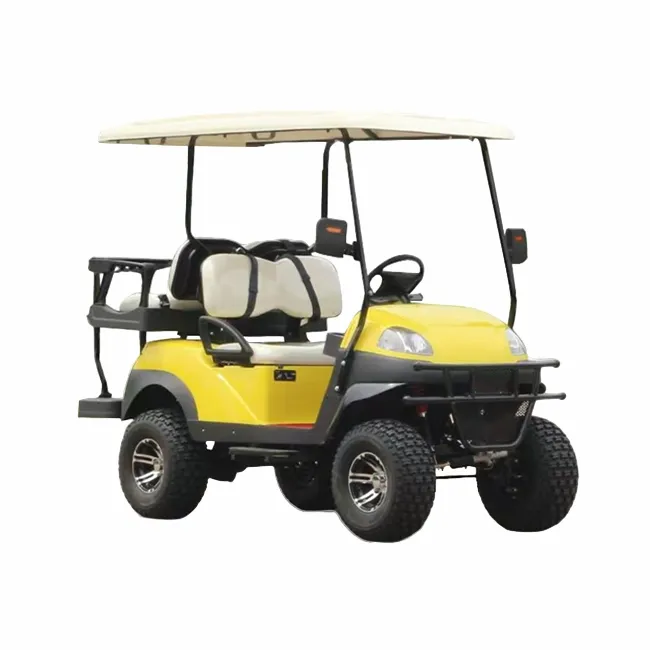
Hey there! As a supplier of 4x4 off-road golf carts, I often get asked about the steering mechanism of these bad boys. So, I thought I'd take a few minutes to break it down for you.
First off, let's talk about why the steering mechanism is so important in a 4x4 off-road golf cart. Unlike regular golf carts that are designed for smooth, flat surfaces, 4x4 off-road golf carts need to be able to handle rough terrain, steep inclines, and tight turns. That means the steering system has to be strong, reliable, and responsive.
There are a few different types of steering mechanisms that you might find in a 4x4 off-road golf cart. The most common ones are rack and pinion steering and recirculating ball steering.
Rack and Pinion Steering
Rack and pinion steering is a popular choice for many 4x4 off-road golf carts. It's a simple and efficient system that works by converting the rotational motion of the steering wheel into linear motion. Here's how it works:
- The Pinion Gear: When you turn the steering wheel, it rotates a small gear called the pinion gear. This gear is connected to the steering column, which runs from the steering wheel down to the front of the cart.
- The Rack: The pinion gear meshes with a long, flat bar called the rack. As the pinion gear rotates, it moves the rack back and forth.
- The Tie Rods: The rack is connected to the steering knuckles on each wheel by a pair of tie rods. When the rack moves, it pushes or pulls on the tie rods, which in turn steer the wheels.
One of the main advantages of rack and pinion steering is its simplicity. There are fewer moving parts compared to other steering systems, which means there's less to go wrong. It also provides a direct and responsive steering feel, which is important when you're navigating rough terrain.
Recirculating Ball Steering
Recirculating ball steering is another option that you might find in a 4x4 off-road golf cart. It's a more traditional steering system that's been around for a long time. Here's how it works:
- The Steering Gear: When you turn the steering wheel, it rotates a steering gear. This gear is a large, circular component that contains a series of ball bearings.
- The Ball Nut: The steering gear meshes with a ball nut, which is a threaded component that moves back and forth along the steering gear. As the ball nut moves, it rotates a sector shaft.
- The Pitman Arm: The sector shaft is connected to a pitman arm, which is a long, lever-like component. When the sector shaft rotates, it moves the pitman arm back and forth.
- The Drag Link and Tie Rods: The pitman arm is connected to the steering knuckles on each wheel by a drag link and a pair of tie rods. When the pitman arm moves, it pushes or pulls on the drag link and tie rods, which in turn steer the wheels.
One of the main advantages of recirculating ball steering is its durability. It's a heavy-duty system that can handle a lot of abuse, which makes it a good choice for off-road applications. It also provides a smooth and comfortable steering feel, which is important for long rides.
Power Steering
In addition to the basic steering mechanisms, many 4x4 off-road golf carts also come with power steering. Power steering is a system that uses hydraulic or electric assistance to make it easier to turn the steering wheel. Here's how it works:
- Hydraulic Power Steering: In a hydraulic power steering system, a pump is driven by the engine or an electric motor. The pump creates pressure in a hydraulic fluid, which is then used to assist the steering. When you turn the steering wheel, a valve opens, allowing the hydraulic fluid to flow to the steering gear. The fluid then pushes on a piston, which helps to turn the wheels.
- Electric Power Steering: In an electric power steering system, an electric motor is used to assist the steering. The motor is controlled by a computer, which senses how much force you're applying to the steering wheel. When you turn the steering wheel, the computer sends a signal to the motor, which then provides the necessary assistance.
Power steering is a great feature to have in a 4x4 off-road golf cart, especially if you're going to be doing a lot of driving on rough terrain. It makes it easier to turn the steering wheel, which can reduce fatigue and make your ride more comfortable.

Choosing the Right Steering Mechanism
So, which steering mechanism is right for your 4x4 off-road golf cart? Well, it depends on a few factors, including your budget, your driving style, and the type of terrain you'll be driving on.
- Budget: Rack and pinion steering is generally less expensive than recirculating ball steering. If you're on a tight budget, rack and pinion steering might be the better choice.
- Driving Style: If you like a direct and responsive steering feel, rack and pinion steering might be the better choice. If you prefer a smooth and comfortable steering feel, recirculating ball steering might be the better choice.
- Terrain: If you're going to be driving on rough terrain, recirculating ball steering might be the better choice. It's a more durable system that can handle a lot of abuse. If you're going to be driving on mostly flat terrain, rack and pinion steering might be the better choice.
Conclusion
The steering mechanism is an important part of any 4x4 off-road golf cart. It's what allows you to control the direction of the cart and navigate through rough terrain. Whether you choose rack and pinion steering, recirculating ball steering, or a combination of both, make sure you choose a system that's reliable, responsive, and comfortable to use.
If you're in the market for a 4x4 off-road golf cart, be sure to check out our selection of Off Road Electric Golf Cart, 3000W Electric Golf Cart Scooters, and Electric Golf Carts 6 Seater. We offer a wide range of models and features to suit your needs and budget.
If you have any questions or would like to learn more about our products, please don't hesitate to contact us. We're here to help you find the perfect 4x4 off-road golf cart for your needs.
References
- Automotive Engineering: Fundamentals, 2nd Edition, by John Heywood
- The Automotive Chassis: Engineering Principles, by Gilles P. Lamontagne
- Modern Automotive Technology, 12th Edition, by James D. Halderman